
English

September 1, 2026
Two quotes. One is cheaper. Eight years later, it wasn't.
Every line purchase starts the same way. Two or three quotes land on the table, the numbers getcompared, and the cheaper machine wins — or the more expensive one has to justify itself. That comparison isn't wrong. It's just measuring the smallest number on the page.
Cost out a filled bag of coffee — not the machine, the bag — and the line accounts for roughly 3% of it. Film, product, energy, labor and downtime are the rest.Those two numbers aren't independent. The 3% is what sets about 75% of everything else. Howmuch film goes into a seal. How much coffee ends up in a bag that gets thrown away. How manyminutes a changeover costs. How many bags come off the line in a shift. That's the inversion that makes quote comparison misleading. You negotiate hard over 3% whilethe same decision quietly fixes the other 75% for the next eight years.
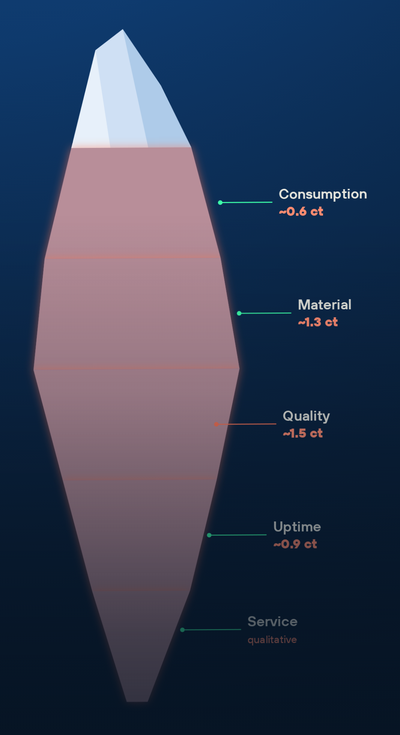
Five factors, for a 250 g reference bag in multi-shift operation.
Across those five factors, the difference between an efficient line and an average one comes thoroughly 4.3 cents per bag — without selling a single additional unit. At typical multi-shift volumes, that pays back the additional investment in under a year. Over the life of the line, the benefit works out to roughly 13 times the extra you paid atpurchase. The higher investment produces the cheaper bag. That reads like a sales line. It's arithmetic.
Or let us run it with you. We built an interactive TCO calculator for exactly this. Give it your volumes, formats, reject rate and downtime, and it works through your case instead of a reference one — in a call, or at the booth in Chicago with your numbers on the screen. It takes about fifteen minutes. You keep the result either way, whether or not you ever buy a machine from us.
Figures are based on industry benchmarks and Hesser Packaging's experience in coffee packaging,consolidated in our TCO model and normalized to a representative reference case: multi-shiftoperation, 250 g bag. Values are rounded and deliberately expressed as relative shares and centsper bag rather than absolute amounts, so they stay comparable across operations.
We would love to hear your opinion, questions or comments.